Designing for Life: Reimagining Nature Finance
Two years ago I stepped away from a high-profile role at the frontier of nature finance. For nearly two decades I worked to make nature investable and build coalitions for action, believing these efforts could tip the balance. Yet for all this effort, nature loss was still accelerating. I began to see how much of what we called progress was simply greening the system rather than transforming it. That was when I realised the deeper challenge: the question is not only how we mobilise more nature finance, but how we confront the nature of finance itself.
Our financial system is extraordinarily resilient. It speaks the language of change, yet its core logics remain intact: the pursuit of risk-adjusted returns, the primacy of financial capital, and the illusion of endless growth. As long as we stay in that orbit, most innovations are absorbed back into the dominant system. We cannot simply optimise, we must also reimagine.
Today we launch ‘Designing for Life: Reimagining Nature Finance’ — an essay that is the first fruit of the Fellowship I am shaping with the Circular Bioeconomy Alliance. Together with the Leverhulme Centre for Nature Recovery at Oxford and my colleagues at Ostara, the essay diagnoses design flaws in today’s system, explores how finance might be redesigned for life, and offers glimpses of alternatives already taking root. Its core message is simple. We must walk a twin trail. One foot inside the system, pushing it to its limits. One foot outside, imagining and nurturing what cannot yet fit. Both paths are essential if we are to shift from breakdown toward renewal.
The essay also served as a pre-read for an imaginal gathering we held earlier in September in Wytham Woods outside Oxford, co-hosted with the Leverhulme Centre. Designed by Ostara and Kate Raworth of Doughnut Economics Action Lab, it brought forty leaders together under canvas and in the forest. We asked not only what must change in finance, but what it might mean to imagine it working differently.
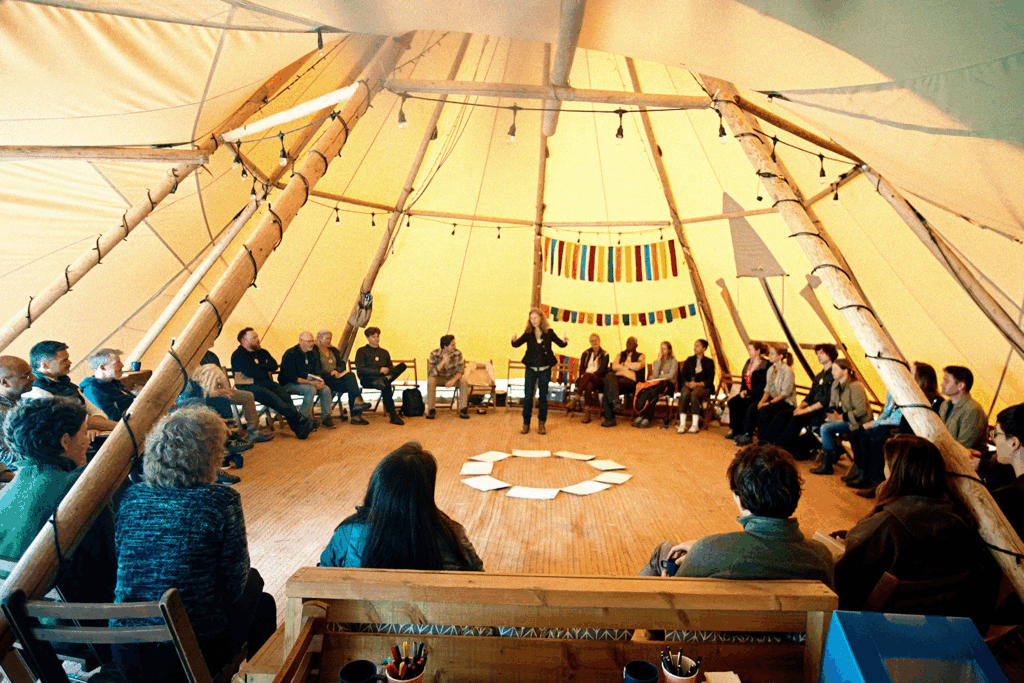
Around fire circles and walking dialogues we asked three simple questions. What must we let go of in the current system. Where can we push harder from within. What might it mean to step outside altogether. As we stress-tested the essay’s provocations, a set of seeds began to take shape.
Among them were ideas for a future generations fund that puts tomorrow’s citizens and nature in the room for investment decisions. A bioregional treasury in Gabon to sustain intact landscapes and shared livelihoods. A networked forest of community-led organisations, using digital tools to make hidden ecological and social value visible and exchangeable. And a Wytham Woods Invitation to gather these insights into clear principles for the road ahead.
None of these is a finished blueprint. They are living experiments, fragile and full of potential. What matters is not whether every seed grows, but that they stretch our imagination of what finance might become if we unshackle it from what we assume is fixed. They complement the essay’s core argument and invite us to glimpse a future that is not yet visible, but possible. We can add to them. And we need more spaces for reimagining, with more support for bold experiments that push the boundaries of what finance can be. Wytham showed what becomes possible when we create room to dream together.
The path ahead will be shaped by the choices we make about finance. It can continue to accelerate collapse, or it can be redesigned in service to life.
This essay serves as a provocation. I invite you to read it, sit with its questions, and join us in asking: what kind of finance would truly serve life?
Download the full essay — Designing for Life: Reimagining Nature Finance
The publication has been led by our Co-CEO Justin Adams in his role as the Circular Bioeconomy Alliance Reimagining Nature Finance Fellow, with the support of Nicole Schwab and Niki Rust from Ostara, the Leverhulme Centre for Nature Recovery, and the University of Oxford.