Wytham Woods Imaginal Studio: Redesigning Finance to Serve Life
A tipi in an ancient woodland. Pouring rain. Thunder.
Locally sourced food. Imagination. A circus.
40 courageous explorers willing to question the fundamental design of our financial system.
An unlikely set of ingredients. And yet, the perfect recipe for our three-day Imaginal Studio in Wytham Woods on the edge of Oxford, UK, to dive into the design principles of our current financial system and ask what it would take to reimagine finance in service of the living world.

It all started with a set of questions, and an unease — the feeling shared by many — that while there is growing momentum around green investments and nature finance innovation, unless we broaden and deepen the nature finance conversation, we risk remaining trapped in a mindset and system that is inherently reductive and extractive.
A daring proposition emerged: what if we hosted a gathering in the heart of an ancient woodland, foundational in the development of the science of ecology, to draw inspiration from the intricacies of the natural world and explore bold new ideas to finance nature’s regeneration? What if we sourced the food for this gathering in a way that embodied the regenerative principles we aspire to foster, using seasonal and local ingredients sourced from projects whose purpose is to nourish people while healing the earth?
We rose to the challenge.
Designing for Life: Reimagining Nature Finance, was published as an essay to provoke our thinking and serve as the starting point for our reflections.
We welcomed participants in a big tipi under the rain, with Kate Raworth’s Doughnut Economics Circus. With the help of a good dose of humour, two participants volunteered to represent nature and finance respectively, and unpack the deep design principles that oppose nature to finance. It was of no surprise that while nature is relational, regenerative, embodied and long-term, finance has been designed to be reductive, accumulative, disembodied and short-term. A challenging starting point if we are to honour the principles of Doughnut Economics: leave no one behind; don’t overshoot the planetary limits.
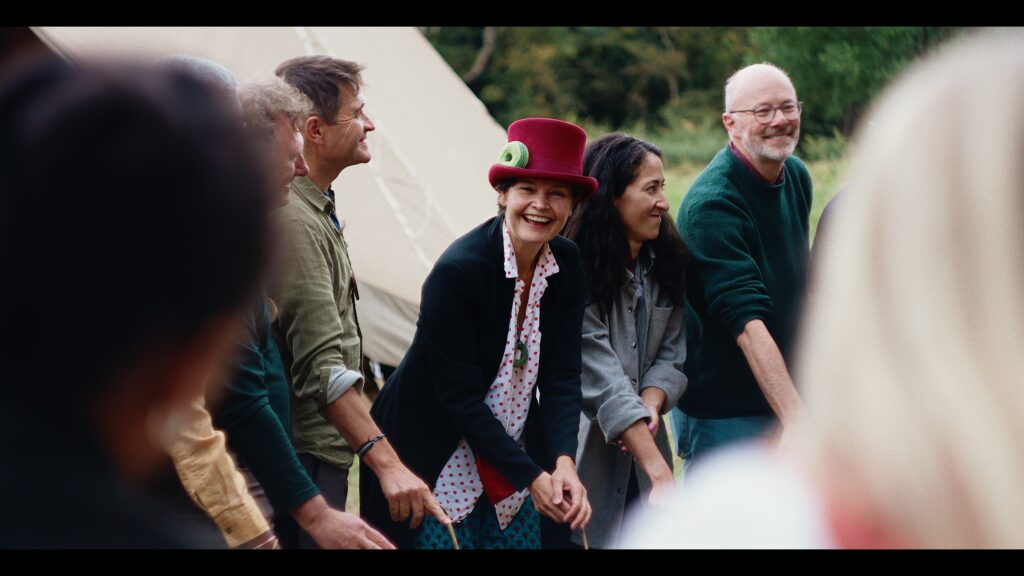
From there, we pushed further into the cracks in the system, using the Berkana Two Loop’s living systems model to explore what keeps us stuck, how far we can push the boundaries from within, and what we need to let go of.
Participants grappled with a series of questions: how can death and decay help us build the new? How can we think more radically, yet make sure there is no dynamic of “otherness”? How do we make sure that what we create is not more of the same? How can we be more deliberate about the change we are seeking? How can we hold the tension between the old and the new? What can we do together that will be different?
By the evening, as the circus re-entered the stage under the fleeting moon, we were ready to collectively give voice to the underlying motives and emotions that drive finance. Fear, Ego and Disconnection were invited onto the stage, while the audience read thought-provoking quotes and poetry from eminent personalities.

As we time-travelled to the end of the century and reflected on our collective legacy, the personified emotions fidgeted on their stools and eventually loosened their grip. Green Finance split into two new personalities, “Boundary Pushing Finance”, and “Finance Redesigned”, willing to inspire our musings on the following day.
The rain did not let up. Yet, it proved a fertile ground to water the many seeds that participants had been holding. Different perspectives, ideas, and nascent initiatives were shared and discussed in small groups. Learnings and questions exchanged. By the afternoon of the last day, six groups had formed, their seeds had become dragons, and they were ready to bring them back into the circus to be tested and challenged by the collective.
The seeds included a storytelling and culture lab to shift finance from within; a place-based currency issued against verified ecological and social plans, with clear guardrails for people and nature; an evergreen fund structure guided by Doughnut principles, where nature and future generations sit at the table with returns recycled into society; a token tied to Gross Ecological Product, co-governed by communities, stewards and state; and a fund-of-funds seeding local DAOs, anchored in 100-year bioregional plans.
As an overarching framework, the last group presented The Wytham Woods Invitation, a concise, actionable invitation to lay out principles for finance in service of life, with teeth around accountability, reallocation and safeguards, ready to be activated in moments of crisis.
After a final shower, the clouds parted and we planted a beautiful oak tree — christened the Dragon Oak — as a symbol of our individual and collective commitment to cultivating the soil in which these seeds may germinate in the coming months and years, and grow into strong resilient trees.
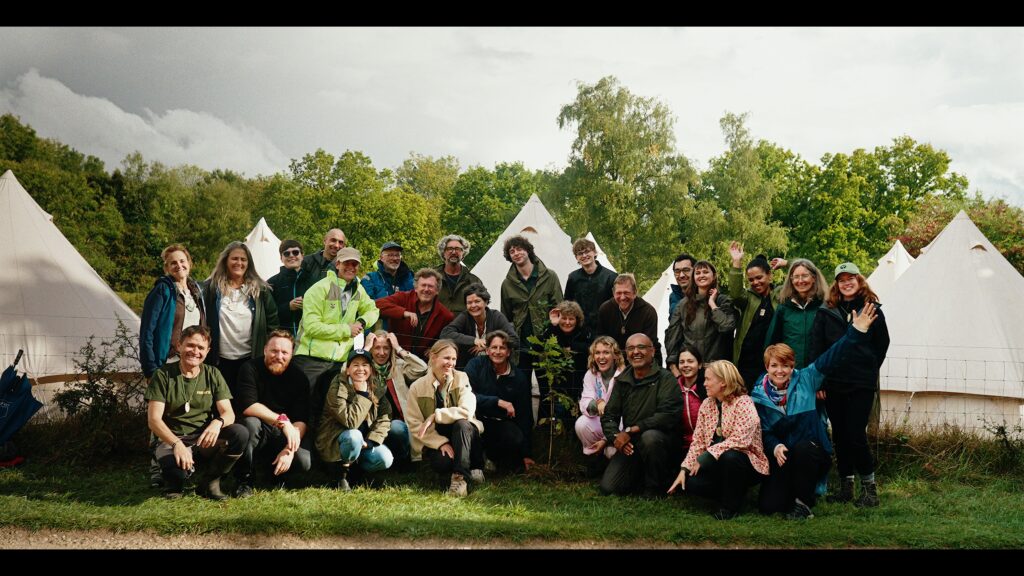
We left nourished by the elements, by the beautiful community of hearts and minds that gathered in the woods, and with renewed inspiration and commitment to work towards an economy that is designed in service of the living world.
***
The Wytham Woods Imaginal Studio was hosted by the ancient woodland of Wytham, and co-stewarded by the Leverhulme Centre for Nature Recovery at the University of Oxford and the Circular Bioeconomy Alliance. It was designed and facilitated by Ostara in collaboration with Kate Raworth of Doughnut Economics Action Lab.